
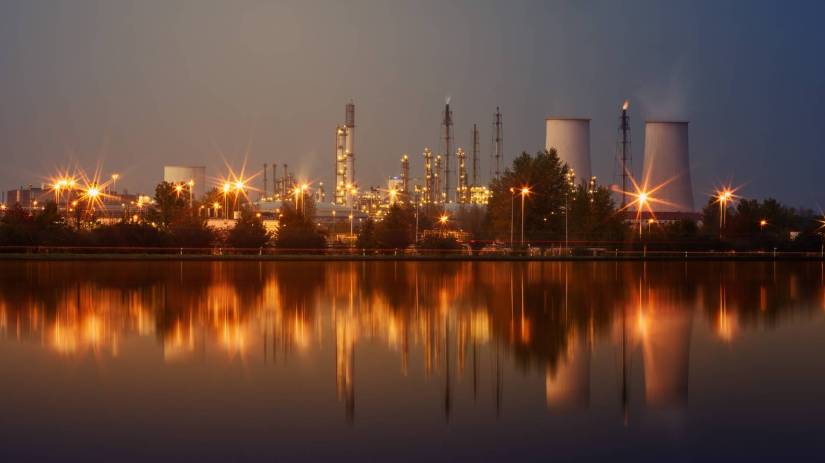
Utilities and Offsite (U&O) are backbone of any processing facility. A robust, reliable and efficient U&O is essential for any process plant to operate in a safe and efficient manner. Generally U&O are centralized units and utilities are distributed to various process plants through distribution network at a processing facility. Designing a flexible, reliable and efficient U&O that can meet various operating scenarios is a challenge.
Utilities are essentially energy carriers. They supply or take away energy from the process plants as per process requirement. (Typical examples of Utilities: Air, Water, Fuel, Electricity, Steam generation and distribution, etc).
Offsite are common supporting facilities for raw materials, finished products, effluents… (Typical examples of Offsite: Tank farms, Water reservoir, Firewater system, Flare system, Interconnecting piping, loading/ unloading, Waste water treatment, etc.)
For any green field project, before pre-commissioning of process plant (s), U&O units should be mechanically complete, commissioned and fully working. These are the first units to go on-stream in any green field project.
Sizing and designing U&O for ever changing demand under various operating scenarios needs a very detailed study and through understanding of various operating scenarios. If there are multiple process plants then the complexity increases further.
Some typical scenarios of Process Plant (s):
- Pre-commissioning
- Startup
- Peak production
- Normal production
- Minimum production
- Partial power failure
- Total power failure
- Planned shut down
- Maintenance during shut down
- Fire/Accident
From the above list, it is clear that requirement of various utilities for each scenario is quite different than the other. Take for example, Nitrogen and Cooling Water. Nitrogen is used for purging or pressurizing equipment to avoid air in grace. Typically Nitrogen requirement is at its peak during pre-commissioning or maintenance during shutdown, while requirement may be minimum during normal operation. On the other hand, Cooling Water requirement during pre-commissioning or maintenance during shutdown is minimum, and may be maximum during peak production.
Apart from the above operating scenarios, seasonal changes, ambient temperature conditions also have a great influence on Utility Demand. During peak summer, cooling water requirement is more while during winter, it is less due to change in ambient temperature. Similarly Air drying unit has to meet fluctuating demand as per humidity of air in changing seasons.
Sizing and selection of appropriate Co-Gen units (where steam and electricity is generated simultaneously) is a major challenge for fluctuating demand of electricity and steam under various scenarios.
As far as offsite are concerned, changes in above factors and also market scenario of demand and supply of raw material and chemicals, storage and dispatch requirement have be taken into consideration while planning offsite facilities.
Considering all above factors, proper sizing and designing of U&O facilities that can meet practically a wide range of 0-100 % demand in an efficient and reliable manner is a challenge.
Proper sizing and designing can be done only when the utility requirements of all the process plants under various scenarios are well understood and a utility consumption summary under various scenarios is made. Typically, accurate information is not always available at the early stage of the project and it keeps on changing due to various reasons. (e.g. actual Utility requirement from a package vendor may be more or less than the estimate during basic engineering). By the time the Utility consumption summary is finalized, the project has already progressed in advance stage. However as mentioned earlier, U&O has to be functional before the process plants can be started. Thus the time frame for Engineering, Procurement and Construction for U&O is very limited in any project. A team of well experienced and expert personnel who have handled U&O projects earlier is essential to meet this challenge.
Sometimes due to various reasons, U&O is not accorded appropriate importance and priority, affecting not only the project completion schedule but also may have long term adverse effect. There have been instances where large projects were delayed due to delays in U&O availability, unstable operations due to improper utility distribution system, shutdown period extended due to limited availability of some utilities; Flare system overloaded due to unforeseen scenarios… the list goes on.
Summing up, U&O is an important part of any processing facility and should be given due importance throughout the project. An efficient and reliable U&O helps in keeping operating costs low, minimize losses and operate process plants in a stable and safe manner.
 Process & Safety Consultant